Phone and device onboarding#
How a house that isn’t on Telegram joins the Red Escudo: a phone somebody already owns, or a device the family buys. Either way it’s the same alert, into the same group, reaching the same people.
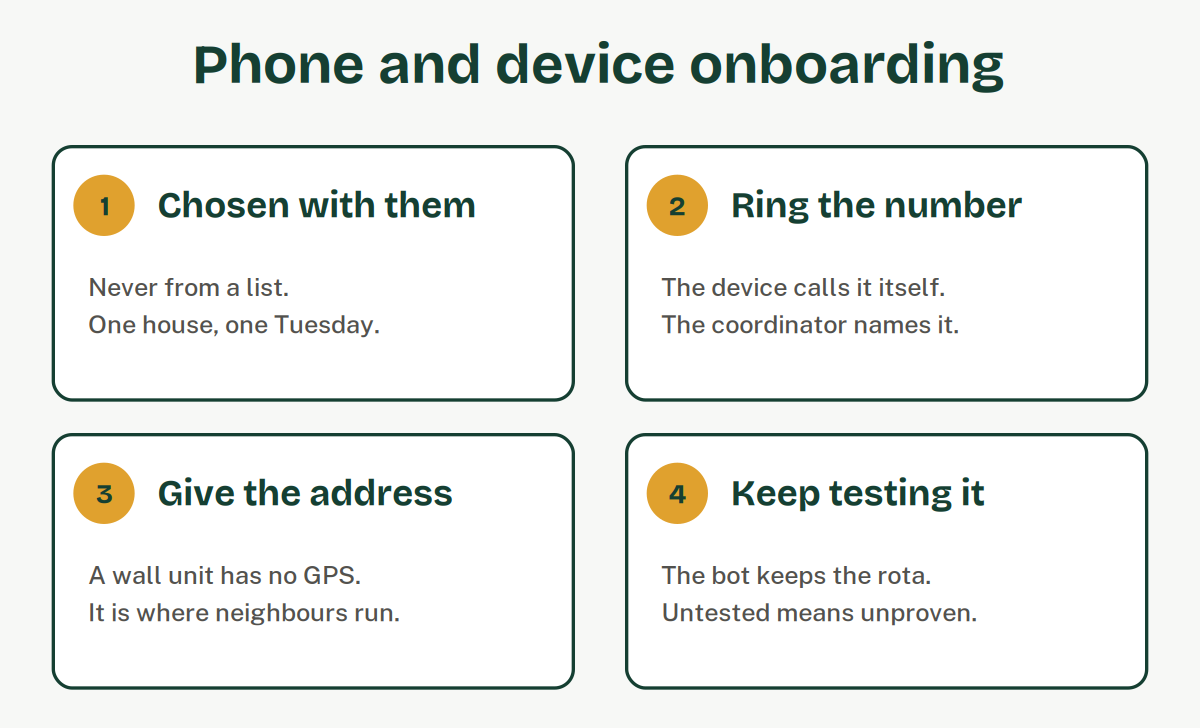
1. Choose it with the person, not about them#
No list of the vulnerable, no committee deciding who is frail. It comes out of an ordinary conversation — usually out of Telegram onboarding, when it’s honest that a phone app isn’t the answer for this person.
And it happens one at a time, for years. This is never a village-wide installation day. Somebody’s sight goes, somebody has a fall and doesn’t want to be alone again, somebody’s hands stop managing a touchscreen. Whatever the village does has to be worth doing for one house on a Tuesday.
There are three ways in, and the family picks:
| What it is | What it costs | |
|---|---|---|
| Telegram | The phone they already use | Nothing |
| A registered phone | The phone they already own, registered as an alarm number. A dumbphone, or a smartphone used only for calls | Nothing |
| A registered device | A base unit with a pendant, a GPS pendant, a watch that detects falls | The family buys it |
Start with the middle one. If the person carries a phone and can press a speed-dial key, that phone is already an Escudo button and it costs nobody anything — a call is an alarm. Buy a device when there’s a reason a phone won’t do: it has to be worn, or it has to work when the person is unconscious, or the hands won’t manage a keypad.
Escudo doesn’t sell, choose or recommend hardware. The requirement is one line — it must be able to call a stored number — and the family buys whatever shape suits them. Show them what the requirement means in a shop, then leave the choice with them.
2. Ring the Escudo number#
Nobody types a phone number into anything. The new phone or device calls the Escudo number, and the coordinator names what arrives.
- The family puts the Escudo number in the device — usually first in its list of contacts, with family numbers after it, following the instructions in the box.
- They press the button once, or ring from the phone.
- The call appears in the coordinator’s panel as an unregistered number.
- The coordinator gives it a name — Casa de María — and an address, and saves it.
That’s the registration. It takes a minute and it can’t get a digit wrong, because the number came from the device itself.
Until it’s named, that number reaches nobody. An unrecognised caller goes to the panel and to the coordinator, never to the village group — otherwise anyone who guessed the number could raise the whole village.
3. The address is the alert#
A base unit screwed to a kitchen wall has no GPS, and a pendant’s position is a best guess indoors. So the address in the registry isn’t paperwork — it’s the location neighbours will run to, and it goes in the alert text.
Write it the way a neighbour would say it, not the way the post comes: the house by name, the door that’s actually used, which floor. If the gate sticks or the key is with the daughter next door, that belongs in the same line.
What’s recorded is that a number belongs to a house. Nothing about anyone’s health is recorded, and there’s nowhere to write it.
4. Set up the calls#
While you’re there, do the part that decides how it feels:
- Who the device rings after the Escudo number. Two or three neighbours who are usually in, family last. The person answering talks to them over the hands-free unit while they’re still on the floor, so this call is the acknowledgment — the proof that somebody heard.
- Press it once, for real. Let them hear the recorded message, then a familiar voice answer. That’s the moment they learn nobody is going to be cross with them for using it.
- The SIM. A prepaid Spanish SIM dies after four to nine months without a recharge. Note whose it is and when it was last topped up. This is the coordinator’s job, not the family’s, because it fails silently.
The test rota#
This is the part that keeps the whole layer honest. A shop-bought device reports nothing about itself — no heartbeat, no battery reading, no way to see that it stopped working in March. It sits in a drawer, the SIM expires, the battery dies, and the village finds out on the day it matters.
So a scheduled test isn’t hygiene. It’s the only proof there is, and it can’t depend on anyone remembering. The bot keeps the rota. Every real alert and every test marks the household proven; after sixty days without one, the panel says so.
Caducado — proven once, but not lately. The routine has slipped. The coordinator opens a test window for that household from the panel and rings to say press it when you like today. The next alarm from that number is logged quietly, confirmed to the coordinator privately, and never posted to the group.
Nunca probado — never proven at all. That’s a different problem: an install that was never finished. Somebody’s got a device in a box, or in a drawer, or with a flat SIM, and nobody has ever seen it work. Go to the house.
Testing this way, rather than with a dedicated test button, is deliberate. It works on any device, including the single-button ones — and the cheap kits have exactly one button. And the resident’s experience during the drill is identical to a real emergency: they press, the phone rings, a neighbour talks to them, minus the village-wide noise. A separate test button rehearses pressing something they’ll never press in anger.
Separately, the whole group gets a drill through the bot — which tests something different and just as important: whether phones make a noise.
If you’re reading this because your village is further along than ours, we’d rather hear about it than guess — the project is open.